
The Science of Movement-Based Learning: Why Active Kids Learn Better
Ask any experienced primary school teacher what happens after a lesson that involved physical activity and they will likely tell you the same thing: the students remember it. They come back the next day still talking about it. They make connections to what they learned weeks later. Body-based learning is not a new idea. Educators have observed its effects for generations. What has changed is the depth of research available to explain why it works.
This article looks at what the science says about active learning, what it means for everyday classroom practice, and why interactive floor technology represents a practical and scalable way to bring these findings into regular teaching.
What Kinesthetic Learning Actually Means
The term kinesthetic learning gets used loosely in education discussions, and it is worth being precise. At its most basic, it refers to learning that involves physical activity or manipulation, doing something with your body as part of the learning process. This is different from simply being allowed to fidget or from watching a physical demonstration. Body-based learning involves the learner using their own movement to interact with the content.
There is an important nuance here. Research has consistently challenged the idea of fixed learning styles, the popular theory that some students are visual learners, others auditory, others hands-on, and that matching instruction to style improves outcomes. The evidence does not support that claim in its rigid form. What the evidence does support is something more useful: that physically active learning activities tend to improve engagement and retention for most learners, not just a supposed kinesthetic subset. The benefit is about the cognitive and physiological effects of being active while learning, and those effects apply broadly.
What the Research Shows
A 2023 study followed 492 students in grades three through five through an eight-week maths intervention. Students experienced both traditional instruction using whiteboards, flashcards, and worksheets, and activity-based learning where physical actions were tied to maths concepts. At the end of the study, the hands-on approach produced significantly higher levels of student engagement compared to traditional delivery methods.
Engagement is not a feel-good metric. A student who is mentally absent from a lesson absorbs nothing, regardless of how well it is taught. Getting students cognitively present in the activity is, in many classrooms, the first challenge and the most consequential one.
A 2024 systematic review examined body-based strategies and vocabulary acquisition in learners across multilingual settings, which is highly relevant to the school populations of Singapore, Hong Kong, the Philippines, and Malaysia. The review found that active participation also contributed to reduced language anxiety. Students who are less anxious in language lessons take more risks, make more attempts, and ultimately progress faster.
Separate research from 2024 found that short, frequent bursts of physical activity during periods of sustained sitting improved metabolic outcomes significantly better than a single longer exercise session. This finding sits at the intersection of physical health and educational outcomes, suggesting that the traditional model of keeping children seated for the bulk of the school day carries measurable physiological costs.
What This Means for Teachers
The research does not suggest that every lesson needs to involve students running around the classroom. What it points toward is integration: finding ways to embed physical activity into the substance of learning rather than adding it as a break from learning.
A five-minute activity break in the middle of a maths lesson is better than nothing, but it treats physical engagement as a reset rather than a teaching method. When the activity is the maths lesson itself, when students are stepping on answers, walking through number lines, or collaborating on a physical problem-solving task, the learning and the movement reinforce each other rather than taking turns.
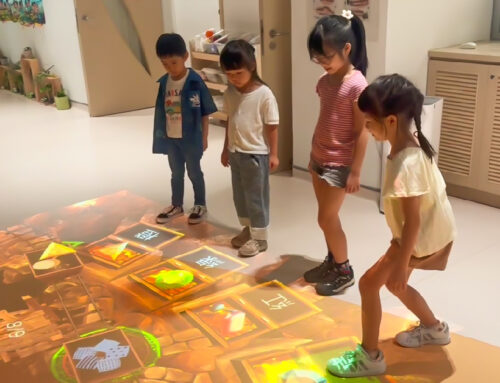
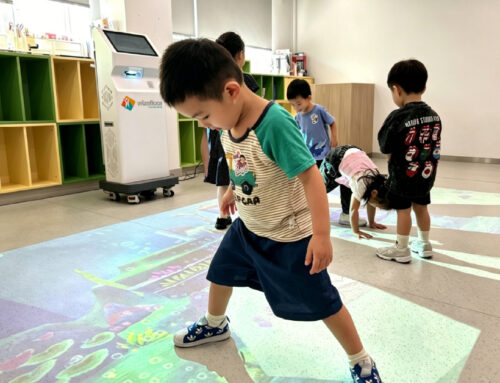
Interactive floor technology is one of the most practical ways to operationalise this principle in a standard classroom. It does not require teachers to redesign their entire programme or invest in expensive physical resources. It creates a space where active participation and curriculum content coexist naturally, within the lesson structure educators already use.
A Note on Inclusive Practice
One aspect of active learning that deserves specific attention is its potential for students with diverse needs. Children with ADHD, for whom sustained seat-based attention is particularly difficult, often perform significantly better in learning environments that accommodate and channel their natural inclination to be active. Children with sensory processing differences can benefit from the proprioceptive feedback that physical engagement provides.
Interactive floor activities can be calibrated for a wide range of physical ability levels. They do not require running, jumping, or coordination beyond what most children in a class can do. The threshold for participation is simply being present and making a choice, which makes them broadly accessible across most classroom populations.