
A New Dimension in the Classroom: How Interactive Floors Work Alongside Smart Boards in Asia
Schools across Asia that have invested in smart board platforms and interactive display systems often ask where WizeFloor fits in relation to those existing tools. They serve different purposes, and many schools are finding that the two work together well within the same classroom.
Smart boards are excellent classroom tools. They bring the teacher's instruction to life on a large, high-resolution display. They support collaborative annotation, digital content delivery, and teacher-led demonstrations. For front-of-room instruction, they do what they are designed to do very well. An interactive floor does something different. It takes the floor of the room, the shared physical space that every student already occupies, and turns it into an active learning environment.
Two Tools, Two Dimensions of the Same Classroom
Think of it this way. An interactive display panel brings technology to the vertical plane of the classroom: the front wall, where the teacher traditionally holds attention. WizeFloor adds the horizontal plane: the floor, where students physically exist during the school day.
Schools that use both find that smart boards and the interactive floor complement each other within the same lesson. A teacher might introduce a concept on the interactive display, demonstrate it, and gather initial responses through the board's collaborative tools. Then students move to the floor-based activity to practise, apply, or explore the same concept through physical participation. The two tools address different stages of the learning cycle rather than duplicating each other.
Educators across Singapore, Taiwan, and the Philippines have developed exactly this kind of blended approach, and the feedback is consistent: the combination gives teachers more range within a single lesson than either tool provides alone.
What the Floor Dimension Adds
The core difference is about who is doing something at any given moment in the lesson. With a front-of-room display, the teacher or a nominated student is typically the active participant. The rest of the class observes.
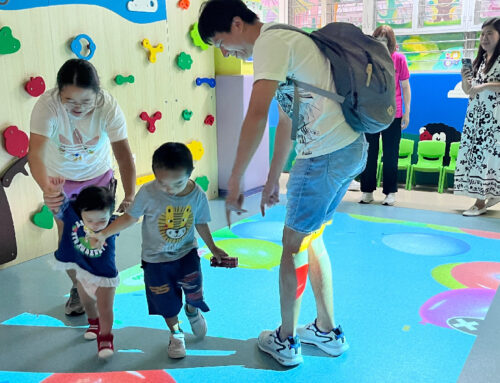
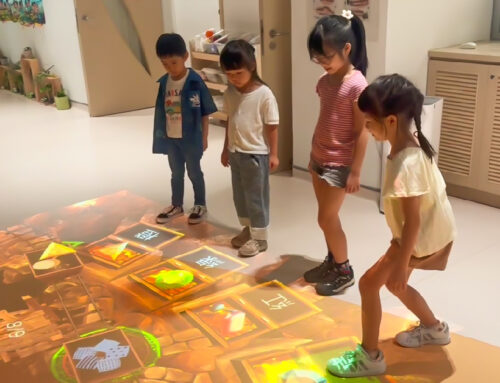
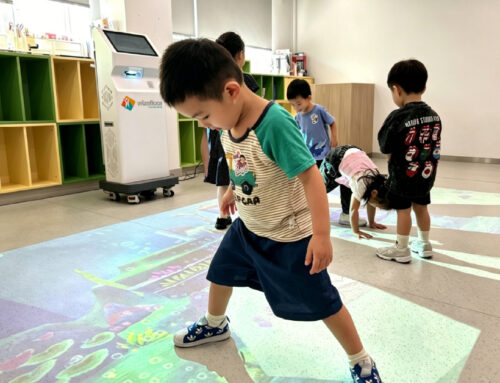
Interactive floor activities are designed for simultaneous group engagement. When content is projected onto the floor, every student in the activity group is making decisions, moving, and responding at the same time. There is no queue. There is no waiting. Participation is the default rather than the exception.
Schools piloting this system alongside their existing display technology have reported participation rates in floor-based activities that substantially exceed those in conventional lesson formats. The figure that appears repeatedly in educator feedback is a shift from roughly 30 percent of students actively engaged during a traditional lesson segment to upward of 90 percent during floor sessions. The hardware in the room did not change. The dimension of the room being used for learning did.
The Research Context in Asia's School Technology Market
The Asia Pacific EdTech market is one of the fastest-growing in the world. In 2026, schools across the region are no longer evaluating technology on the basis of presence alone. The question has shifted from whether to use technology to which tools produce measurable improvements in learning outcomes.
Singapore's Masterplan 2030 for education technology specifically calls for active, participatory learning experiences. Taiwan's Ministry of Education digital transformation initiatives have created procurement pathways for innovative teaching tools. In markets including the Philippines and Malaysia, expanding EdTech distribution networks are reaching school populations that previously had limited access to interactive learning technology.
In this environment, the combination of a high-quality interactive display for front-of-room instruction and an interactive floor for whole-class physical participation gives schools a toolkit that addresses both dimensions of the modern learning environment.
Practical Considerations for Schools With Existing Display Technology
For schools that have already invested in smart board platforms, the interactive floor does not require replacing or modifying anything. It is a standalone system that operates independently. It can be introduced into any learning environment alongside existing displays without compatibility concerns.
The offline operation of WizeFloor Ultra is worth highlighting in this context. Unlike cloud-dependent tools that require network access to function, WizeFloor Ultra runs from its built-in storage. Schools with mixed-reliability internet infrastructure can deploy WizeFloor confidently knowing that connectivity issues will not disrupt a floor session in progress.