
Introducing The Science behind WizeFloor
WizeFloor is pleased to present The Science behind WizeFloor, an educational rationale originally prepared in January 2015 to document the thinking behind our movement-based learning platform.
From the beginning, WizeFloor was built on a simple but powerful belief:
Children learn more meaningfully when they are actively involved — physically, socially and cognitively.
Written by Kaj Grønbæk, Professor at Aarhus University, the rationale explains how WizeFloor grew from the earlier Wisdom Well concept and why interactive floor learning was designed around movement, play, collaboration and teacher-created content. The report also notes that Wisdom Well had been documented in research venues and recognised with the Red Dot Design Award in the Educational Products category.
Although the rationale was prepared in 2015, the educational question behind it has become even more relevant today:
How can schools use technology to create active learning experiences, rather than simply adding more screen time?
By making this rationale available through WizeFloor's Research & Practice resources, we hope to give schools, educators and decision-makers a clearer view of the educational foundation behind WizeFloor — beyond the hardware, beyond the projection, and beyond the game experience.
WizeFloor is not only about making learning more interactive. It is about helping children move, think, communicate and learn together.
Download The Science behind WizeFloor
Learning Through the Body, Not Only Through the Screen
Many digital learning tools still ask children to sit, watch, listen and tap. WizeFloor takes a different approach.
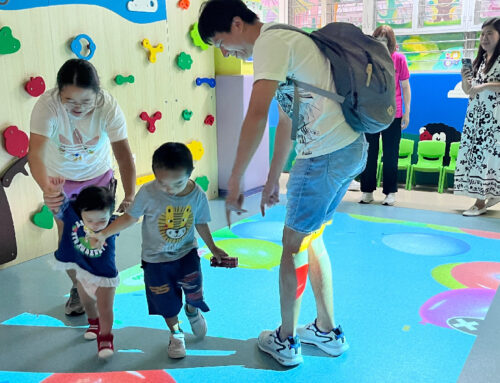
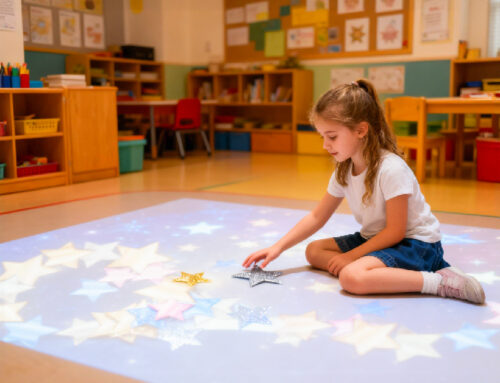
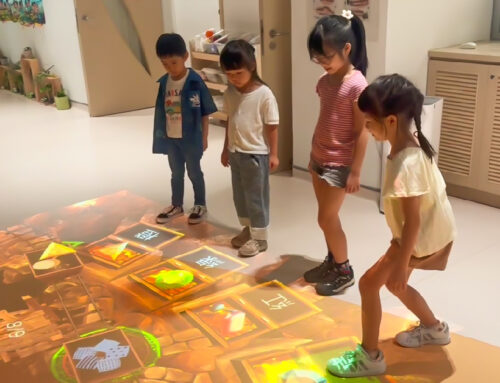
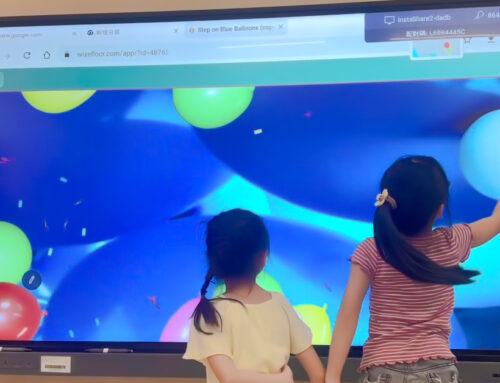
The floor becomes a shared learning space. Children can step, move, point, match, discuss, decide and respond together. The body is not treated as separate from learning. It becomes part of how children explore ideas, communicate with peers and build understanding.
This is the core idea behind movement-based learning. It is not about movement for entertainment. It is about using purposeful physical participation to support thinking, memory, engagement and collaboration.
The 2015 rationale describes this through the idea of body-kinaesthetic learning, where children use movement as part of the learning process, rather than interacting only through eyes, ears and fingers.
What Current Research Says About Movement-Based Learning
The educational language has changed since 2015, but the direction of research still supports the value of active learning.
A 2022 systematic review found that learning through movement can be an effective, low-cost and enjoyable strategy for elementary schoolchildren.
The CDC also notes that classroom physical activity can improve student academic performance and behaviour.
This matters because engagement is not a decorative outcome. A child who is not mentally present in a lesson learns very little, no matter how strong the teaching materials are.
Movement does not replace good teaching. It gives teachers another way to help children become present, responsive and involved.
For WizeFloor, this has always been the point: technology should not make children more passive. It should invite them into the learning experience.
Three Learning Principles Behind WizeFloor
1. Collaborative Learning
WizeFloor was designed as a shared learning environment, not a one-child-one-screen experience.
Several children can participate at the same time. They can discuss answers, take turns, help one another and solve tasks as a group. This supports subject learning, but it also supports communication, confidence, self-regulation and social participation.
In early years and primary classrooms, these moments matter. A child may learn from the question, from the movement, from the peer discussion, or from watching how others approach the task.
Learning becomes visible, social and active.
2. Movement-Based Understanding
On WizeFloor, children do not only look at learning content. They move through it.
They can step on letters, jump to numbers, walk across maps, match sounds with images or move as a team to complete a challenge.
This helps turn abstract ideas into physical and memorable experiences. For young learners, that difference is important. A number, a word, a sound or a concept can feel very different when it is placed into a space the child can physically enter.
WizeFloor makes the learning space larger, more visible and easier to share.
3. Teacher-Created Content
One of the strongest ideas in The Science behind WizeFloor is that teachers and children should be able to create their own content.
This remains one of WizeFloor's most important strengths.
Schools do not need another fixed library of activities that gradually becomes less relevant. They need a platform that can adapt to their curriculum, language, culture, themes and student needs.
A kindergarten may create activities around festivals, emotions, phonics or daily routines.
A primary school may design content for English, Chinese, mathematics, STEAM, general studies or values education.
An SEN centre may adjust activities according to attention span, sensory needs, motor ability or communication goals.
The platform becomes stronger when teachers can make it their own.
Supporting Kindergartens, Primary Schools and SEN Settings
Kindergartens
Young children naturally learn through movement, play, sound, images, imitation and social interaction.
WizeFloor helps teachers turn early literacy, numeracy, theme-based learning and social development into active experiences. Children can participate through stepping, matching, listening, responding and working with peers.
For kindergartens, movement is not a distraction from learning. Very often, it is the way into learning.
Primary Schools
Primary schools need technology that supports real teaching goals.
WizeFloor can be used for language learning, mathematics, STEAM, general studies, values education, quiz activities and project sharing. The value is not movement alone. The value is movement connected to clear learning objectives.
A spelling task can become a team challenge.
A maths question can become a physical decision.
A map can become an interactive floor activity.
A presentation can become a shared learning moment.
SEN and Inclusive Learning
Inclusive learning requires flexibility. Not every child participates best through the same instruction, response format or pace.
WizeFloor gives children more than one way to take part. Some learners may respond better through movement, matching, stepping, pointing, listening or visual recognition than through verbal or written answers.
This aligns with wider developments in inclusive education technology. UNESCO IITE highlights the importance of ICT infrastructure, inclusive learning environments and teachers' competence in integrating technology into pedagogy.
WizeFloor should not be understood as a clinical intervention or a guaranteed therapeutic solution. It is a flexible learning platform that helps teachers create active, multi-sensory and socially engaging learning experiences for diverse learners.
From Educational Rationale to Classroom Practice
The Science behind WizeFloor is not being presented as a new research paper. It is being shared as part of WizeFloor's educational foundation.
Its value is not in claiming to be new. Its value is in showing that WizeFloor was designed with a clear pedagogical purpose from the beginning.
Since 2015, WizeFloor's technology, content and classroom applications have continued to evolve. Yet the central idea remains the same:
Children should not be passive users of technology. They should be active participants in learning.
That is the reason this rationale still belongs in today's conversation about education technology.
Schools are not simply looking for more screens. They are looking for better learning experiences — experiences that are active, inclusive, collaborative and meaningful.
Conclusion
WizeFloor is more than an interactive floor.
It is a movement-based learning environment designed to help children think, respond, collaborate and learn through active participation.
By presenting The Science behind WizeFloor, WizeFloor gives schools a clearer understanding of the educational thinking behind the platform — and why movement, play, collaboration and teacher-created content continue to matter in modern learning.
When children move with purpose, learning becomes more visible, memorable and meaningful.
FAQs
Reference
WizeFloor, The Science behind WizeFloor, educational rationale, January 2015.
Petrigna et al., 2022, Does Learning Through Movement Improve Academic Performance in Primary Schoolchildren? A Systematic Review.
CDC, Classroom Physical Activity.
UNESCO IITE, 2025, Digital Technologies for Inclusive Education.