
When a Classic Philosophy Meets the Tools of the Digital Era
Montessori education emphasizes sensory experience and self-directed exploration. In today's digital era, tools such as interactive floors, interactive projection floors, and gamified learning give new life to this philosophy, enabling attention training, cognitive training, and sensory integration in natural ways.
Montessori's Place in Education
As one of the most influential educational philosophies of the twentieth century, Montessori reshaped the way people understand learning. Developed by Dr. Maria Montessori, the method is built on the principle of child-centered learning. It recognizes children's intrinsic motivation to learn and emphasizes sensory experience and hands-on materials as pathways to understanding abstract concepts. Today, thousands of schools and institutions worldwide adopt Montessori as the foundation of their curriculum.
Beyond early childhood and primary education, Montessori has also been widely applied in special education and intergenerational learning, highlighting its universality. More than a teaching method, it is an educational philosophy that respects individuality, values autonomy, and has inspired modern approaches such as inquiry-based learning, experiential learning, and interdisciplinary teaching.
Core Principle: From Concrete to Abstract
One of Montessori's most recognized principles is the pathway from concrete to abstract. Children first learn through their hands, using materials such as rods, letters, or geometric shapes to discover patterns in math, language, and science. Sensory involvement transforms learning from rote memorization into tangible experience.
Yet these concrete exercises are not the final goal but a bridge to abstract thinking. Through repeated practice, children internalize that quantities can be represented by symbols, language can be organized by rules, and space is governed by proportions. These concrete experiences gradually evolve into mental imagery, enabling children to solve problems mentally, write sentences, and construct logical arguments.
This journey from hands to mind is at the heart of Montessori: starting with the senses, arriving at abstract thought.
A New Horizon for Digital Learning
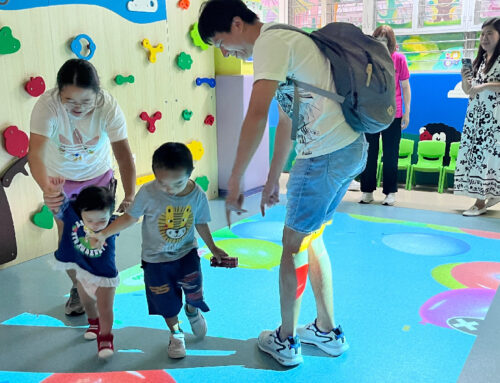
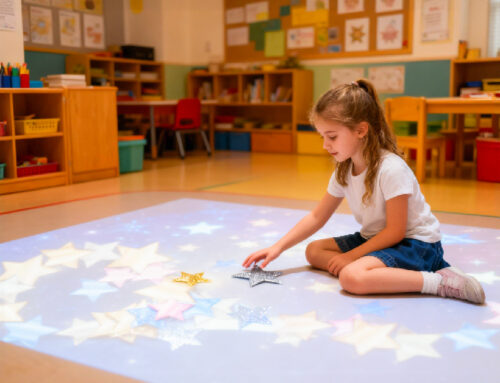
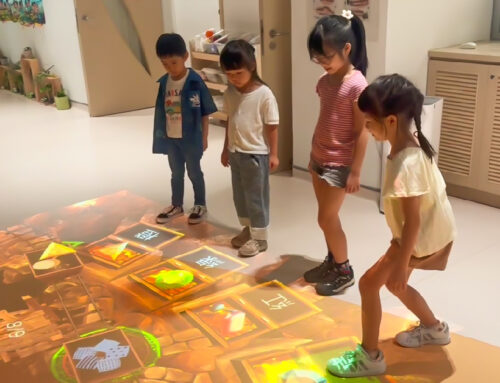
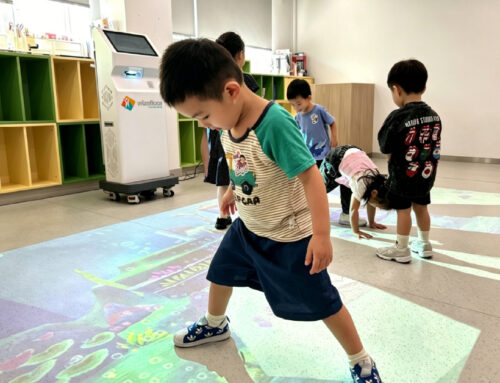
While traditional materials remain valuable, digital interaction brings new dimensions to the classroom. Interactive floors and projection floors expand activities from the tabletop to an immersive environment, inviting children to explore with their whole bodies. They can step, jump, and move collaboratively to achieve goals.
Gamified learning turns abstract rules into clear tasks and rhythms. Attention training and cognitive training unfold naturally as children engage in interactive challenges. The result is a learning environment full of vitality, where knowledge connects more closely to lived experience.
When Digital Becomes Montessori's New Language
In Montessori classrooms, materials are often described as a language that helps children make sense of the world. Today, digital interaction is becoming another language. It does not replace rods or blocks but introduces learning through light, sound, and movement in new ways.
• Child-centered: Digital tools adapt difficulty and pace, acting as an upgraded form of traditional materials.
• Self-directed exploration: Interactive floors offer multiple pathways, empowering children to decide strategies and extend autonomy.
• Sensory integration: Sounds, visuals, and touch occur simultaneously, offering a fuller realization of the pathway from senses to mind.
• Social interaction: Multiplayer digital tasks become a shared language among children, turning learning into a collective rhythm.
Digital language and Montessori language exist side by side: one through tactile exploration, the other through embodied interaction with technology. Together, they expand the child's universe of learning.
Where Tradition Meets Innovation
In one kindergarten math class, the teacher used both Montessori number rods and a WizeFloor activity. Children first arranged rods to understand quantity, then walked out addition and subtraction steps on the interactive projection floor. This dual-track approach made abstract numbers visible, tangible, and verifiable. The experience deepened understanding while showing how traditional and digital tools complement each other.
When Philosophy Meets Tools
Montessori's spirit does not fade with technology; instead, technology offers new ways to embody it. Interactive floors and projection systems make the journey from concrete to abstract more flexible. WizeFloor is not a replacement but an extension—a new language that enriches Montessori practice.
WizeFloor stands out for its focus on self-creation and intensity of participation. Children and teachers can design their own games, set rules and visuals, and make learning closely aligned with self-directed exploration. Immediate feedback fosters focus, while collaborative missions build community, echoing Montessori's emphasis on social learning.
From Classic to Future: Unlimited Possibilities in Education
Montessori is a classic, and digital tools are extensions. Together, they generate new energy rather than competing forces.
Children gain a more complete experience by combining hands-on practice with digital interaction. This synthesis is both a tribute to the past and a step toward the future.
Most importantly, digital tools help Montessori's core ideas take root in contemporary classrooms. Autonomy thrives when children make choices on interactive floors; sensory learning is amplified by light, sound, and movement; and the transition from concrete to abstract is reinforced through gamified challenges and self-created content.
In such environments, children are not merely completing tasks—they are living Montessori's vision: respecting each child's individuality and allowing knowledge to be constructed at their own pace.
FAQs
Prepare Your Students for the Future
Want to explore more about the academic exchange and interactive learning tips? Read our other articles to see how interactive technologies and immersive learning open new possibilities for schools.