
Inside the Taichung classroom
What does participation sound like in an English lesson? In this WizeFloor Taiwan school film, it can begin with one pupil whispering an answer to a classmate. At the Affiliated Experimental Elementary School of National Taichung University of Education, the headteacher and teachers describe lessons in which pupils move, discuss images and prompts, solve a puzzle and even think about designing games for one another.
The film is a window into the school's approach, rather than a test of attainment. Its most useful detail is how teachers respond to the children around the interactive floor: the pupil who needs encouragement, the teammate who offers a clue and the classmate waiting nearby who still wants to help.
Watch the classroom film first, then explore the teaching decisions behind each scene.
Watch the complete WizeFloor Taiwan school case film (approximately three minutes).
A quiet answer can start an English conversation
An English teacher in the film says staff keep encouraging pupils throughout an activity. A child may answer quietly or pass an idea to a teammate rather than speaking to the whole room. The teacher treats that contribution as a starting point. Once images or prompts appear on WizeFloor, children talk to one another about what they see and what to do next. In the teacher's account, those exchanges become oral practice.
That observation matters because speaking practice is more than taking turns to give a polished answer to the teacher. Pupils can rehearse a word, explain a choice and listen to a peer before sharing more widely. The film does not measure language progress, but it shows the social setting in which those conversations can happen.
Why bring the activity onto the floor?
One teacher contrasts the projected floor with a familiar classroom arrangement in which pupils face a board or screen, watch and listen. WizeFloor changes the position of the task: the images are beneath the pupils' feet, and they can respond through movement as well as speech. The point is not that every lesson needs technology. It is that a shared physical task can give a group a concrete reason to notice, choose, explain and act together.
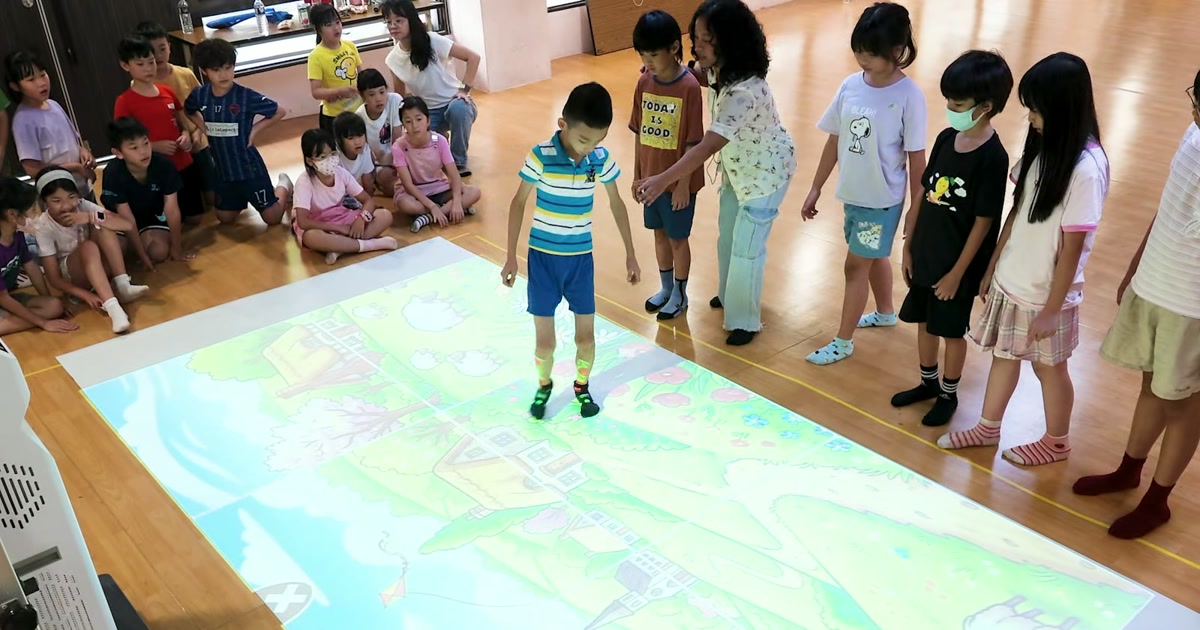
In the filmed activities, some children step onto the projection while others look on. Teachers still decide the learning question, how pupils take turns, and how a child can participate without standing on the floor. The floor is an interface for the lesson; it does not supply the teaching objective by itself.
A puzzle makes teamwork visible
The teacher describes a puzzle game in which some pupils become flustered while others begin to organise the clues and guide their teammates. This is a recognisable classroom moment: children do not all arrive at an answer at the same time or in the same way. The shared task creates an opening for one pupil to ask for help and another to explain a possible next step.
The teacher compares that interaction with a conventional task using textbooks or worksheets, where this kind of collaboration can be harder to draw out. That is the teacher's experience in this school, rather than a universal comparison. What the film clearly shows is a group facing one visible problem, talking through it and adjusting their approach together.
Reading becomes a reason to discuss evidence
A second teacher wants children to move beyond quiet, individual reading towards problem solving. Different opinions are welcomed as part of the task. If pupils disagree, the suggested response is to return to the text, discuss what it says and look again for an answer. The activity therefore has a reading purpose as well as a playful surface.
For a school planning a similar lesson, this is the design question to keep: what must pupils understand in the text before they can make a choice on the floor? A prompt might ask them to match an image to a passage, sequence events or justify a character's decision. Those are possible lesson designs, not claims about the exact activities in the film. The teacher can listen for the explanation that follows the movement.
From playing a game to designing one
The teachers also describe how technology lets them design activities themselves. For older pupils in the school's gifted programme, they discuss a further possibility: pupils creating a game for classmates to play. That shifts the pupil's role from answering a question to deciding what question will test someone else's understanding.
To make a useful game, a pupil has to choose a source text or learning idea, anticipate possible answers and decide what feedback a player should see. The teacher connects this with a more demanding form of reading comprehension. The film presents it as a teaching direction and classroom experience; it does not report a measured improvement in comprehension.
The rest of the class is part of the lesson
One of the film's strongest observations comes from the children around the floor. A small group may be operating the projection, yet classmates watching nearby want to offer suggestions and help. The teacher says the activity feels successful when the whole class is absorbed in the shared task, rather than only the pupils whose turn it is.
That does not happen automatically. A teacher can give observers a question to answer, invite them to explain a clue before the next turn or ask them to compare two solutions. When visiting a lesson, school leaders can listen for those contributions as well as watching the pupils on the projection. The film offers a useful prompt for observation: who is thinking, speaking and helping when they are not physically playing?
What this Taiwan case can help schools plan
Taiwan's official 12-Year Basic Education curriculum guidelines describe the principles of initiative, interaction and the common good (自發、互動、共好). The headteacher connects the school's experience with those ideas. In the film, pupils are encouraged to contribute, negotiate different views and help their peers. This is one school's example of an approach to discuss, not proof that a device alone delivers a curriculum outcome.
Before trying an interactive activity, a teaching team could agree on three checks: what content must pupils explain, what role will children waiting their turn have, and what evidence will show understanding afterwards? Those questions help connect movement and collaboration to English, reading or another subject goal. Explore WizeFloor games and activities for formats that teachers can adapt, and visit the WizeFloor Academy for more classroom stories.
See the classroom conversations for yourself. Watch the full Taiwan case film. If your school is planning an English, reading or cross-curricular activity, contact WizeFloor Asia to discuss a demonstration.